
REVIEW · CHICHEN ITZA TOURS
Chichen Itza: Self-Guided Tour with Audio Narration & Map
El Castillo feels different with GPS audio. This self-guided walk turns Chichén Itzá into a stop-by-stop lesson, with offline GPS and hands-free audio narration that triggers as you move. You’ll get context for the big moments (like El Castillo, the ball court, and the observatory) plus a suggested route so you’re not wandering around guessing what you’re looking at.
The main drawback is tech dependence. You must download the tour in strong Wi‑Fi/cellular before you go, and you’ll want headphones plus a charged phone so the app doesn’t stall mid-walk.
In This Review
- Key highlights to know before you go
- Offline GPS audio in Chichén Itzá: how it actually plays in the heat
- Price and value: what $9.99 buys you (and what it doesn’t)
- Starting at 97751: getting oriented when no one meets you
- Handicraft Market and the official guide stop: warming up before the big ruins
- El Castillo plus the ritual core: what to look for on the pyramid and the platforms
- El Caracol and the Maya-Toltec blend: where the city explains itself
- Las Monjas, La iglesia, and the tiny details that make ruins feel alive
- Pace management: walking distance, shade breaks, and common app hiccups
- Should you use an audio route instead of a live guide?
- Who this Chichén Itzá self-guided audio tour suits best
- Bottom line: should you book this tour
- FAQ
- Is the $9.99 ticket for entry into Chichén Itzá?
- Does the audio tour work offline once I’m onsite?
- How long does the tour take?
- What language is available?
- Do I need to bring headphones?
- Will I have someone meeting me at the start?
- What devices are recommended?
- Do all stops include admission ticket access?
- What should I do if the audio won’t play?
- Can I get a refund if my plans change?
Key highlights to know before you go
- Offline GPS map means you can keep moving even with no signal once the tour is downloaded.
- Auto-play audio starts when you reach each story point, so you can focus on the ruins.
- A guided-by-your-feet route covers the essentials in about 2–3 hours and over 2 miles of walking.
- More than 37 audio stories come with audio plus images and text at key spots.
- English narration is included, and the tour works on iPhone iOS 15+ and Android 9+.
- Some stops do not include admission, so you’ll still need the official site ticket plan on your visit.
Offline GPS audio in Chichén Itzá: how it actually plays in the heat
This tour is built around a phone app (Action’s Tour Guide App), not a person holding a microphone. After you book, you’ll get an email and text with setup instructions and a password. You’ll then download the separate audio tour app while you still have strong Wi‑Fi/cellular, because the key promise is that it works offline with GPS alone afterward.
Once you’re onsite, there’s no meeting point host. You open the audio tour app at the starting location, pick the tour version that matches your planned starting direction, and start walking. The audio plays on its own when your GPS location lines up with each stop. The result is that you’re not glued to a handheld map or trying to read tiny interpretive signs in Spanish—your phone becomes the guidebook, timed to your steps.
Two practical notes matter a lot here. First, keep earbuds/headphones ready, because the audio can begin as you approach and sometimes even slightly before you physically reach a point. Second, because the tour is GPS-driven, your phone battery becomes part of the plan—one common snag people note is battery drain, so bring a portable charger if you can.
Still on the Maya trail? More Chichen Itza runs
- Chichén Itzá Skip-the-Line Entrance Ticket★ 4.0 · 343 reviews
- Private Guide Service in the Archaeological Zone of Chichen Itza★ 5.0 · 151 reviews
- Chichen Itza: Self-Guided Tour with Audio Narration & Map★ 4.5 · 72 reviews
Price and value: what $9.99 buys you (and what it doesn’t)
At $9.99 per person, you’re paying for the audio guide experience itself: the route, offline maps, stop-by-stop narration, and the app that tells you what you’re looking at. You are not paying for entry into Chichén Itzá—the official admission ticket is explicitly not included.
That distinction is where the value shows up. If you normally like a guide for context but don’t want to pay guide + entry package pricing, this is a budget-friendly way to get the “what am I seeing?” part without scheduling, waiting, or joining a group pace. Several people in the feedback specifically called out that they felt they weren’t missing out versus hiring a paid guide, especially because GPS helped them get back onto the route after detours for photos and souvenirs.
Just be realistic about tradeoffs. An audio tour can guide your attention, but it can’t answer surprise questions. If you want a conversation, or you want someone to adapt to your interests on the fly, a human guide may still be worth it. This tour is best for people who want structure and context while staying flexible.
Starting at 97751: getting oriented when no one meets you
Your tour starts and ends back at the same place, near public transportation, at 97751 Chichén-Itzá, Yucatan, Mexico. No one will stand there handing out tickets or holding a sign. Your job is to show up, launch the app at the first story point, and let the narration take over.
Do a quick orientation before you commit to the full route. One key tip that shows up in user experience: spend a minute aligning yourself so the GPS route starts working smoothly. After that, the tour tends to flow stop to stop.
Also remember: the app is designed to work along a suggested route and speed limit. If you wander far off the path, the GPS-based audio cues might lag or misfire. Staying within the tour route makes the auto-play system feel effortless instead of frustrating.
Finally, if something goes wrong with audio playback, there is support you can contact. One iPhone-related access issue was handled with a refund in the feedback, which tells you the provider takes tech problems seriously—but you still want to make the start work smoothly by downloading and testing before you enter the main walking areas.
Handicraft Market and the official guide stop: warming up before the big ruins
You begin with Handicraft Market (about 5 minutes, admission ticket free on the tour points). This is less about a single monument and more about setting the tone. The narration frames Chichén Itzá as the home of a lost Mayan civilization and primes you to look for meaning rather than just shapes.
Right after that comes a very short stop about Guías oficiales de la Z. A. de Chichén Itzá Tu Guía Yucatán (again, about 5 minutes, ticket free). It’s a quick context piece about the Mayan civilization’s dominance and advancement in Mesoamerica. Think of it as the intro you’d get at the start of a tour—except you can walk through it at your own pace.
One practical advantage of this section: it’s an easy entry point before you tackle the heavier hitters like El Castillo and the ball court. If you’re visiting in the heat, early stops also give you a moment to settle in, adjust your headphones, and find a rhythm.
El Castillo plus the ritual core: what to look for on the pyramid and the platforms
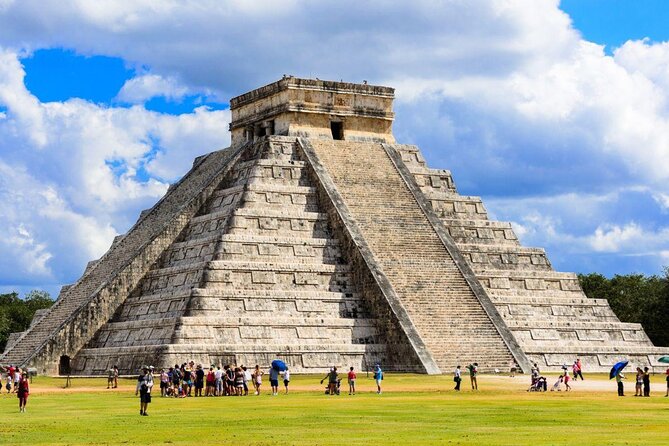
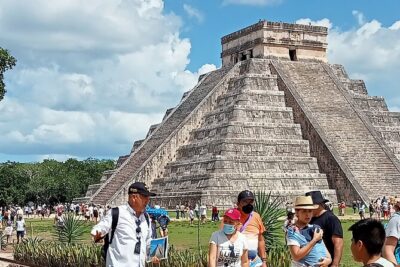
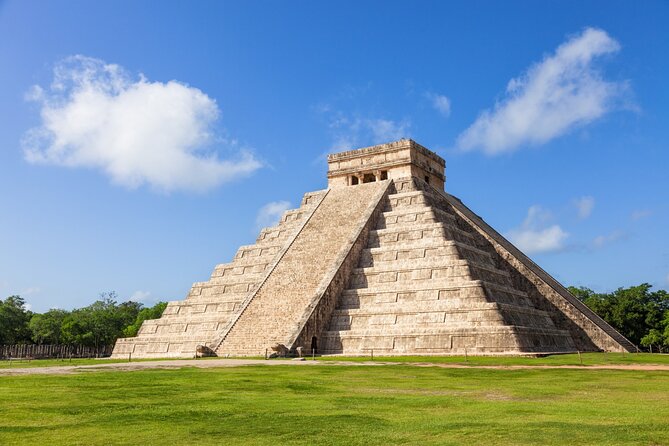
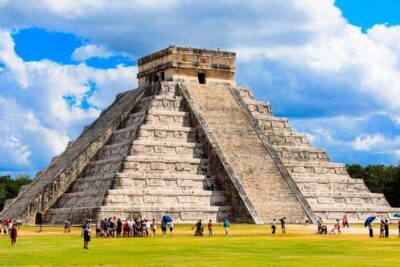
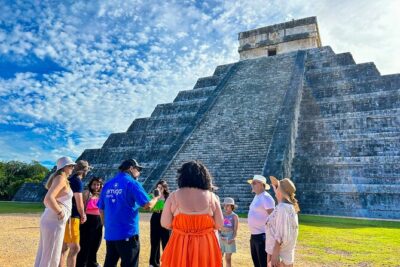
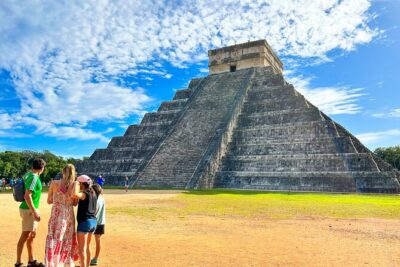
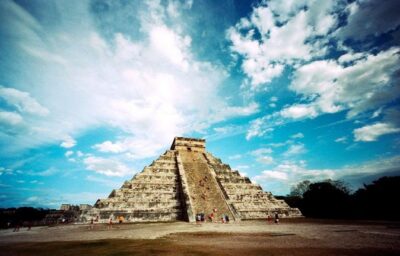
El Castillo (Pyramid of Kukulkan) is the star stop. The audio gives it about 10 minutes and explains why it matters—built to honor the snake deity Kukulkan, and closely tied to Mayan understanding of ritual and cosmology. Expect this to be the most photographed structure, and expect to want a slower walk around it so the details land.
A tip for getting value out of an audio stop like this: don’t just pose for the shot and move on. The audio is designed to teach you what you’re seeing, so pause long enough for the narration cues. Even if crowds are thick, you can still control your time by stepping aside when you need to breathe and then returning for the moments you care about.
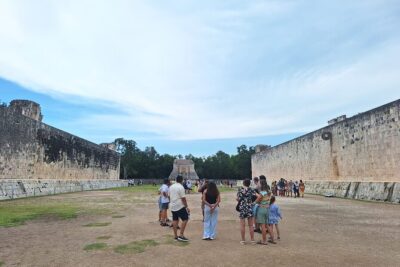
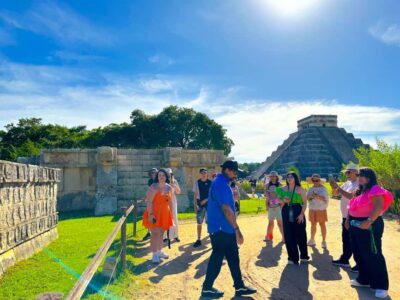
Next is the Gran Juego de Pelota (the Great Ball Court) (about 5 minutes, ticket free). The audio focuses on cultural meaning and how the space connects to Mayan life, not just sport. You’ll also get a “look closely” prompt: six sculpted reliefs line the walls, and ball players in multiple scenes become visible when you inspect the carvings carefully.
Then you reach Tzompantli (about 5 minutes; ticket not included at that stop point). “Skull rack” is the translation, and the narration treats it as a memorial-like structure where the heads of sacrificial victims were placed after sacrifice. The platform depicts warriors carrying human heads, skulls, snakes, and eagles on the walls. This is one of those places where an audio guide earns its keep—without context, it’s easy to see a wall of shapes and move on without grasping what the site was used for.
After that comes Eagles & Jaguars Platform (about 5 minutes, ticket free). This isn’t capped with a temple; the description frames it as a flat ceremonial stage with stairways on each side. It’s likely linked to dance, ritual, or public speeches. If you like the “how people gathered here” angle, this stop can feel surprisingly human—like you’re picturing a crowd before a ceremony.
Stacks up well against these Chichen Itza picks:
El Caracol and the Maya-Toltec blend: where the city explains itself
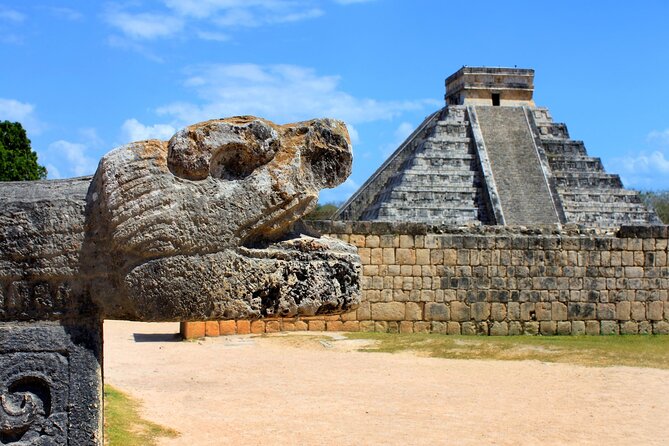
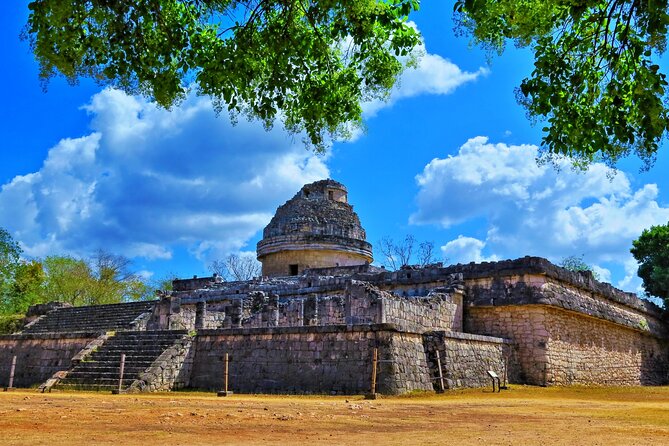
El Caracol is one of the most interesting structures because it connects stone architecture to sky-watching. The stop is short (about 5 minutes), but the story is clear: an observatory sits above, and Mayans would watch stars and use the movement of planets to infer what might come next. It’s the kind of thing that makes Chichén Itzá feel more like a scientific calendar than just a pile of dramatic ruins.
Then the route expands at Chichen Itza Yucatan (about 1 hour; ticket not included at that point). This is the longer “big picture” stop and it matters if you want more than a highlight reel. You get a sweep across Chichén Itzá’s nearly 1,000-year history and how different peoples left marks on the city.
The narration also leans into a fusion idea: Mayan construction techniques paired with new elements from central Mexico. That mix is presented as a reason Chichén Itzá stands out among examples of Mayan-Toltec civilization in the Yucatán. If you only listen to the short pyramid-and-platform stops, you’ll still enjoy the visit—but the long stop is what helps the site feel connected instead of scattered.
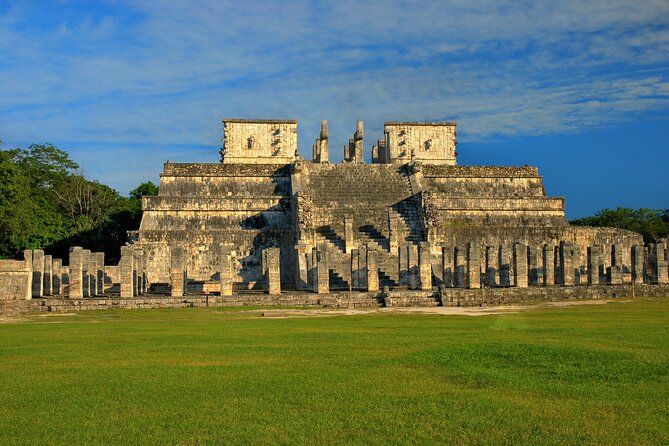
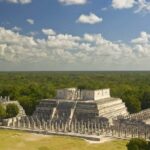
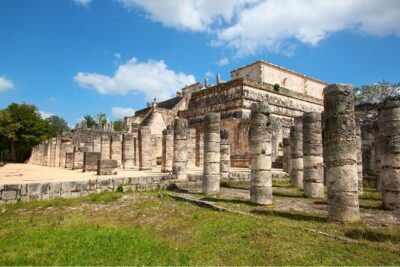
Temple of the Warriors follows (about 10 minutes; ticket not included at that point). It’s described with a vivid comparison: three thick tiers like an expensive wedding cake, topped by a small temple. What you’ll want to notice is the heavy column field—around 200 columns, each carved with Toltec warriors in varying scenes. If you like texture and repetition, this stop rewards patience.
You’ll also encounter El Caracol again later in the route (another El Caracol stop, about 5 minutes, ticket free on that specific point). That repetition isn’t necessarily wasted time. It gives you a second chance to catch the story after you’ve already absorbed more of the site.
Las Monjas, La iglesia, and the tiny details that make ruins feel alive
After the big social and ceremonial stops, the tour turns toward architecture details—those are often what you miss when you’re tired or rushing.
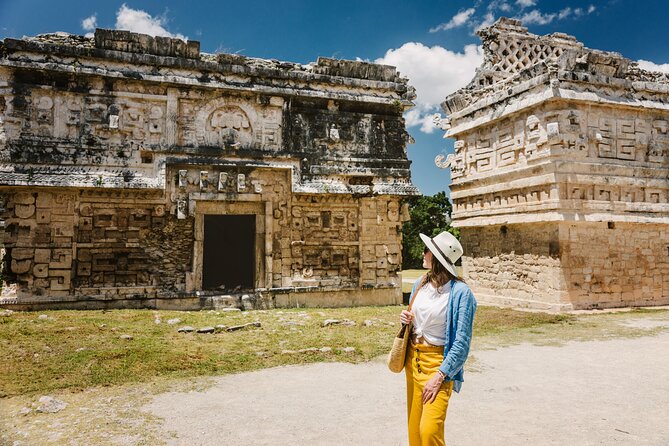
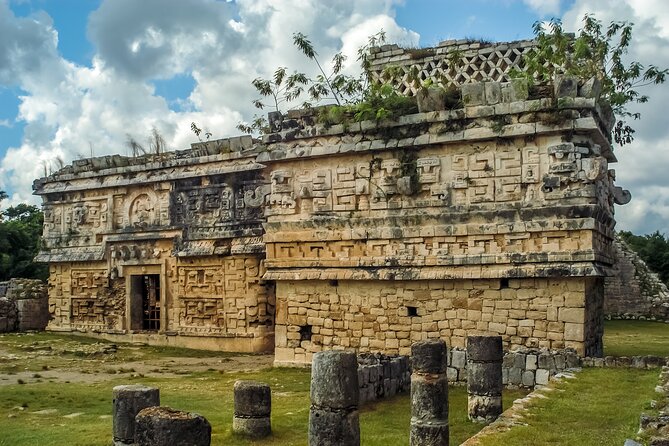
Red House (also known as the House of Little Holes) takes about 5 minutes (ticket free). The key detail is the latticework on top, which makes it look like little holes. The narration gives the Mayan name Chichanchob and suggests it could mean small holes. Even if you’re not an architecture nerd, this is a satisfying stop because it gives you a specific visual target: look for the pattern, not just the shape.
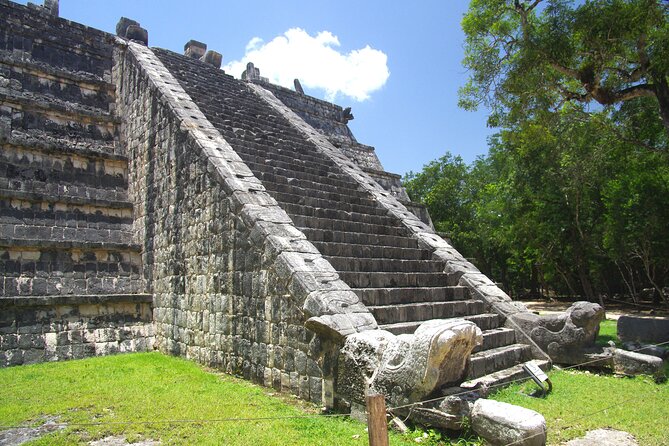
The Ossuary (called the Ossuary / El Osario in parts of the route) appears with two closely related stops. The first Ossuary stop (about 5 minutes; ticket not included) explains the pyramid gets its name from numerous human remains uncovered there. A cavern beneath the pyramid contained seven tombs, believed to belong to members of Mayan high society.
Later, El Osario (about 5 minutes; ticket free on that tour point) repeats the idea with a slightly different framing: it’s also known as the High Priest’s Grave, and the name comes from human and animal bones found on site. If you’re trying to keep the story straight, treat these as two angles on the same structure—one focused on what archaeologists uncovered, the other focused on how the name and meaning are described.
Then comes Las Monjas, the Nunnery (about 5 minutes; ticket not included). The narration emphasizes its size and why it’s archaeologically significant: huge numbers of texts inscribed into the walls, many mentioning a ruler named Kakupakal. This is one of the best stops in the whole route if you like “words carved into stone” rather than only buildings and symbols.
La iglesia (La Iglesia) is another crowd favorite (about 5 minutes; ticket free). It’s one of the most photographed buildings, and the description is visual: the exterior is almost completely covered with veneer decorations. Masks of Chac decorate two upper stories, and among the chacs you’ll also find armadillo, crab, snail, and tortoise details. This is a stop where you’ll get the most out of your audio by actually slowing down and scanning the exterior surface rather than just snapping one photo.
Pace management: walking distance, shade breaks, and common app hiccups
Chichén Itzá isn’t a sit-down museum. This audio route is over 2 miles long, with a duration of about 2 to 3 hours total if you cover all the essentials. One review called out that it took around 2 hours to complete, which lines up with the route design and the short stop lengths.
You’ll want to plan for walking and sun. The provided information notes there are refreshments stalls and sitting areas in the compound, which makes a big difference if you’re stopping to listen closely at each point.
On the app side, a few practical issues are worth knowing so you’re not caught off guard:
- Audio can trigger early: one report notes the audio sometimes starts playing before you reach the exact location. Keep headphones in, and let the narration guide you as you catch up.
- The map can be a bit off: another report describes the map as slightly off. The silver lining is that GPS still helps you navigate back to the intended route.
- Battery drain is real: if you’re using GPS and audio for 2+ miles, bring a charger.
- If something acts stuck during setup: one report says closing and reopening the app fixed a code-entry issue.
- If playback fails after purchase: there was an iPhone access issue in feedback that resulted in a refund, but you’ll still want to test early and follow the download instructions carefully.
If you keep these in mind, the tour tends to feel smooth: location-based audio, clear stop sequence, and the ability to pause and revisit a segment if you missed a detail.
Should you use an audio route instead of a live guide?
This tour is a strong match if you want control and lower cost. The audio lets you avoid huddling around someone and gives you the freedom to step away for photos, souvenirs, or just a minute to breathe in the shade. Several people specifically highlighted that the GPS brought them back onto the trajectory when they went off track.
It’s also a good match if you like learning in short bursts. Many stops are just 5 minutes, so you can listen, look, and move on without feeling like you’re stuck through a lecture.
But be aware of one limitation: audio stops are still limited compared to a human guide’s ability to answer follow-up questions. One feedback note said the info can feel brief and didn’t cover why the city was abandoned, and that official signage can be minimal. If you crave deeper storytelling beyond the essentials, you might want a small amount of pre-reading before you go, so the audio gives you context instead of just key facts.
Who this Chichén Itzá self-guided audio tour suits best
Book this if:
- you want a budget-friendly way to get guiding-style context
- you prefer exploring at your own pace, especially to dodge big crowds
- you’re comfortable walking 2+ miles and standing for photos
- you like GPS-triggered narration and don’t mind using your phone as a tool
Skip or think twice if:
- you dislike relying on tech outdoors (GPS + audio + battery)
- you don’t plan to bring headphones
- you expect admission itself to be included (it isn’t)
- you want a live person to explain things in real time and answer questions
Bottom line: should you book this tour
If your main goal is to see Chichén Itzá’s big structures and understand what you’re looking at—without paying for a private guide—this $9.99 audio tour is a smart value. The offline GPS and hands-free audio make the site feel organized, and the route covers the essentials in a way that helps you learn while still moving through the ruins naturally.
Just treat it like an outdoor tech setup: download on strong Wi‑Fi, bring headphones, and protect your battery. If you do those three things, you’ll likely come away feeling like you didn’t just visit—you understood.
FAQ
Is the $9.99 ticket for entry into Chichén Itzá?
No. The tour price is for the self-guided audio experience. Entrance to Chichén Itzá is not included, so you’ll still need to arrange the official ticket.
Does the audio tour work offline once I’m onsite?
Yes. The tour is designed to work offline after you download it, using GPS alone. No cellular data roaming is needed during the visit.
How long does the tour take?
Plan on about 2 to 3 hours for the full route (roughly 2 miles of walking) if you cover the essentials and listen through the stops.
What language is available?
The tour is offered in English.
Do I need to bring headphones?
Headphones/earbuds are recommended for the best experience, since the audio is hands-free and triggered by your location.
Will I have someone meeting me at the start?
No. This is fully self-guided. You go to the starting point, open the audio app, and begin with the first story where the audio will start automatically.
What devices are recommended?
An iPhone running iOS 15 or later, an Android device running version 9 or later, or an iPad/tablet with GPS and cellular connectivity are recommended for navigation.
Do all stops include admission ticket access?
No. Some specific stops note Admission Ticket Not Included, while others are ticket free at the tour points. You’ll want to check your plan for official entry coverage.
What should I do if the audio won’t play?
If you face audio issues, contact support. It’s also worth double-checking that you downloaded the tour on strong Wi‑Fi/cellular before arriving and that the app is open when you start.
Can I get a refund if my plans change?
There is free cancellation. You can cancel up to 24 hours in advance for a full refund, based on the local time of the experience.
More Tours in Chichen Itza
- Private Tour in Chichen Itza Official History Guide★ 5.0 · 36 reviews
- Chichen Itza Guided Group Walking Tour – Last minute booking★ 5.0 · 32 reviews
- Chichen Itza : Walking Tour with Expert Guide and Skip-the-Line Access!★ 5.0 · 30 reviews
- Chichen Itza Walking Tour in Portuguese or Italian Skip the Line Access★ 5.0 · 24 reviews
- Chichen Itza: Tour with Expert Guide without lines!★ 5.0 · 17 reviews
- Chichen Itza Walking Tour with Audioguide (no ticket)★ 4.5 · 16 reviews
More Tour Reviews in Chichen Itza
- Chichén Itzá Skip-the-Line Entrance Ticket★ 4.0 · 343 reviews
- Private Guide Service in the Archaeological Zone of Chichen Itza★ 5.0 · 151 reviews
- Mayan Experience in Chichen Itza★ 5.0 · 53 reviews
- Private Tulum Experience & Cenote★ 5.0 · 39 reviews
- Private Tour in Chichen Itza Official History Guide★ 5.0 · 36 reviews
- Chichen Itza Guided Group Walking Tour – Last minute booking★ 5.0 · 32 reviews
Chichen Itza, A Few More Ways
- Chichén Itzá Skip-the-Line Entrance Ticket★ 4.0 · 343 reviews
- Private Guide Service in the Archaeological Zone of Chichen Itza★ 5.0 · 151 reviews
- Mayan Experience in Chichen Itza★ 5.0 · 53 reviews
- Private Tour in Chichen Itza Official History Guide★ 5.0 · 36 reviews
- Chichen Itza Guided Group Walking Tour – Last minute booking★ 5.0 · 32 reviews
- Chichen Itza : Walking Tour with Expert Guide and Skip-the-Line Access!★ 5.0 · 30 reviews
Just off the dock: the newest Chichen Itza reviews

Chichen Itza Tours, compared.
 ★ 5.0Chichen Itza, Cenote, and Valladolid TourFrom $4524,293 reviews
 ★ 4.5Chichen Itza, Cenote & Valladolid Tour with Tequila and LunchFrom $3415,789 reviews
 ★ 4.6Chichen Itza, Cenote & Valladolid Tour with LunchFrom $496,722 reviews
 ★ 5.0Early morning Chichen Itza Tour: Cenote and Tequila TastingFrom $266,657 reviews
 ★ 4.5Chichen Itza Early Access All Inclusive: Hotel Pick up & All FeesFrom $1654,123 reviews
 ★ 5.0Chichen Itza Gastronomic, Valladolid and Cenote ExtremoFrom $292,558 reviews
 ★ 4.0Chichen Itza Day Trip Exclusive Nool-Ha Cenote & Valladolid VisitFrom $1101,501 reviews
 ★ 5.0Tour to Chichen Itza-Tickets, food and cenoteFrom $921,479 reviews
Browse the lists this tour appears in